Short answer: yes, but only half of it. Eligible non-US users pay no ordinary broker commission on US stocks, yet every order still carries a platform fee — about $0.35 (fixed) up to $350, and about 0.1% above that. The earlier platform-fee promotion ended on August 31, 2026, so the base rate applies now.
That fee hurts small orders most: on a $10 fractional buy it is 3.5% of the order, and section 2 has a table showing the share at different sizes. The spread and currency conversion add costs that never appear on the bill; section 3 goes through them. The fee figures were re-checked against Binance Academy on September 6, 2026; the Binance order screen is what counts when you trade.
1. What "zero commission" actually means
Commission is only one line item in the total cost of trading. Zeroing it out doesn't mean the whole trade costs nothing. In the real world, the cost of a US-stock trade is usually built from several pieces stacked together: broker commission, platform or clearing-type fees, small regulatory levies, and the hidden cost baked into the bid-ask spread. Zero commission touches the first piece. The others don't vanish because of it.
2. How the platform fee works: flat on small orders, percentage on large (with worked examples)
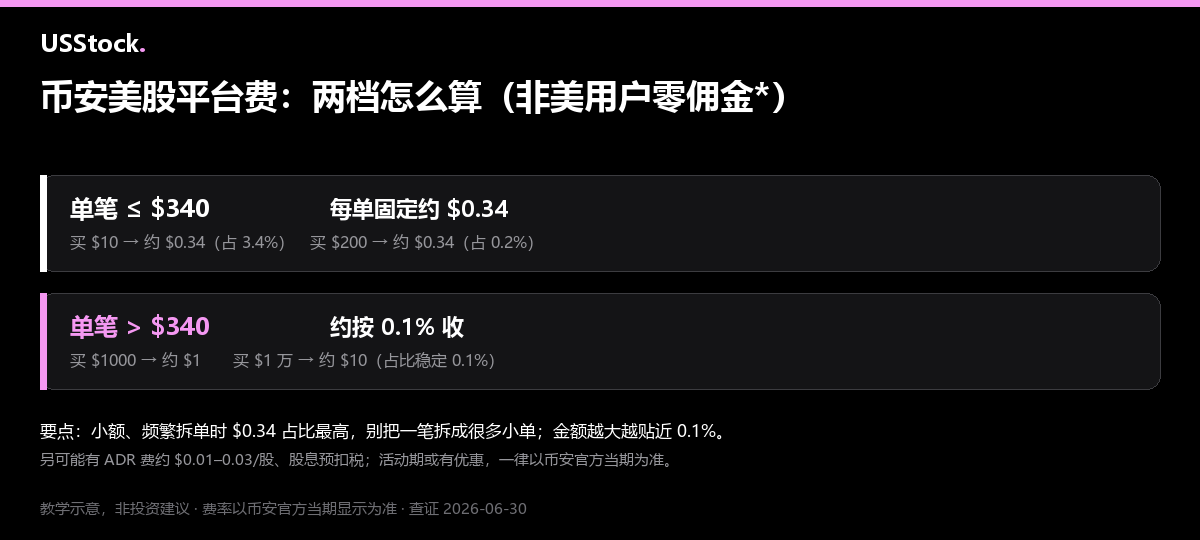
The platform fee comes in two tiers: roughly $0.35 flat when a single order is ≤$350, and roughly 0.1% when it's >$350 (for example about $1 on a $1,000 buy, about $10 on a $10,000 buy; per Binance current terms). Viewed on its own, $0.35 is tiny. The catch is that within the small-order range it's a relatively fixed charge — it doesn't scale down proportionally as your order shrinks. Which means the less you buy, the larger a share of your principal that $0.35 represents. Above $350, the fee switches to a percentage and settles at roughly 0.1%. That's precisely why people who trade small and often should factor it in.
Here's a rough worked example to make the trend visible. The figures use "about" and "roughly" on purpose — they're meant to show the shape of the thing, not to quote you to the cent:
| Order size | Platform fee (≤$350 ≈ $0.35 / >$350 ≈ 0.1%) | Fee as a rough share of principal | What it feels like |
|---|---|---|---|
| About $10 | About $0.35 | Roughly 3%–4% | A high share — worth watching |
| About $50 | About $0.35 | Roughly 0.7% | Noticeably easier |
| About $200 | About $0.35 | Roughly 0.2% | Essentially negligible |
| About $1,000 | About $1 (at 0.1%) | Roughly 0.1% | Past $350 — now percentage-based |
| About $10,000 | About $10 (at 0.1%) | Roughly 0.1% | Share stays around 0.1% |
The table makes one plain but important point: the same $0.35 stings very differently on a $10 buy than on a $200 buy. On $10, the platform fee alone swallows roughly 3%–4% of your principal — meaning the stock has to climb back that much before you break even. On $200, the share drops to around 0.2% and all but disappears.
None of this is to say small orders are off-limits. If you're in a learning phase and just want to experience the flow with a tiny amount and get comfortable with the interface, treating $0.35 as tuition is entirely reasonable. The point is simply to go in clear-eyed — don't assume "zero commission" means every little trade is free.
3. Zero commission ≠ completely free: the other hidden costs
Beyond that platform fee (≈$0.35 when ≤$350, ≈0.1% when >$350), a few more costs belong in your mental model:
1. The bid-ask spread
There's usually a small gap between the price you can buy at and the price you can sell at. This isn't a line item on your statement — it's an "invisible" cost. Large, liquid stocks generally have narrow spreads; thinly traded names, or moments of sharp volatility, can widen them. It never shows up under "commission," yet it genuinely affects the price you get filled at.
2. Currency-conversion costs
Many users hold their home currency and need to convert into tradable funds before buying US stocks. The conversion path itself, and the exchange-rate spread within it, is another cost to count. It sits on a separate line from broker fees, which is exactly why it's easy to overlook. To work this line out, see how to calculate USD/CNY conversion costs.
3. Small levies and current-term adjustments
Some markets carry tiny regulatory levies — usually very low, but real. More important: every fee can change as Binance updates its policies. The figures I saw when verifying on 2026-06-30 may not match the terms in force on the day you actually place an order. Building the habit of "glance at the current fee breakdown before ordering" is far more reliable than memorizing any fixed number.
Put those pieces together and you get a truer picture: zero commission saves you the customary commission, but the full cost of a trade is the sum of the other items on top. Looking at it through a "total cost" lens is what keeps the phrase "zero commission" from leading you astray.
4. Fractional shares from about $5: another path for small accounts
If your account is small and you still want to buy stocks with a high per-share price (a single share can run into the hundreds), fractional shares are unavoidable. The fractional threshold here is roughly $5, meaning you can buy a slice of "less than one share."
The upside is that fractional shares let small accounts take part in high-priced stocks and spread their holdings. But set them next to the platform fee above and you'll notice something: fractional + small + frequent is exactly the scenario where the platform fee's share peaks. Buy $5 of a fractional share and the roughly $0.35 fee is a hefty proportion. So fractional shares suit "wanting to learn, try, and diversify," but if you're chasing cost efficiency, try not to push every trade down to the bare minimum. For how the mechanism works, what you can buy, and the limits, see the dedicated piece on what fractional shares are and how to buy them.
5. Eligibility and scope
With the costs covered, one thing has to be stated plainly: not everyone can use this. This kind of US-stock feature for non-US users is generally open only to eligible non-US users. US users can't use it; whether other regions are open depends on Binance's terms and your account.
In other words, if you're in the US, count as a US person for tax purposes, or your region isn't covered, don't rush to weigh whether $0.35 is worth it. First confirm whether you're within the eligible scope at all. Before registering, sorting out your region's compliance requirements and whether you qualify as a "non-US user" matters far more than saving on that fee. For the related risk and disclaimer notes, it's worth reading the risk warning and disclaimer.
One more reminder: this article covers only the fee structure and common misconceptions. It is not investment advice — it recommends no specific stocks, predicts no market moves, and promises no returns. Low fees do not mean easy money; markets rise and fall, principal can be lost, and you should act within your means.
6. How I adjusted my own ordering habits
Here are a few small habits I set for myself once I understood the $0.35 thing; adapt them to your own situation:
- Don't make tiny buys just to join in. Practicing is fine, but keep in mind the roughly 3%–4% platform-fee share on a $10 buy — don't treat it as costless.
- Buy in one go rather than over-splitting. Without a clear staged-entry strategy, breaking one buy into a dozen small orders just piles on minimum platform fees.
- Glance at the current fee breakdown before ordering. Rates change as Binance adjusts; what I remember is the logic, not a fixed number.
- Count the conversion cost too. Beyond the US-stock fees, don't skip the conversion line. Use the on-site calculators to add both together and see the total.
These habits won't guarantee profit — that's not what they're for. They just help you control the costs you can control, freeing your attention for what really matters: what you actually want to buy, why, and how much volatility you can stomach.
Frequently asked questions
Is Binance stock trading really zero commission?
The commission part really is $0, but trading isn't free. Each order carries a platform fee — about $0.35 flat up to $350 and about 0.1% above — plus the spread and any currency-conversion cost.
Is the platform fee charged on every order? How is it calculated?
Every order has one, in two tiers: roughly $0.35 flat when a single order is ≤$350, and roughly 0.1% when >$350 (about $1 on a $1,000 buy, about $10 on a $10,000 buy). Exact triggers and calculation follow Binance's current rules. The key point is that within the small-order range it's relatively fixed, so its share climbs noticeably — frequent small splits are especially uneconomical.
My account is small — are fractional shares worth it?
Fractional shares start at about $5 and suit small accounts for learning and diversifying. But fractional + very small + frequent buying is exactly the combination where the platform fee's share peaks, so watch for it if you're after cost efficiency. Estimate first with the fractional-share tool.
I'm in the US — can I use it?
No. It's only for non-US users, so US users can't use it; elsewhere, whether it's open depends on Binance's terms and your verification result. Confirm your region's eligibility before registering.
This article is fee education and process explanation only. It is not investment advice; it recommends no individual stocks, predicts no market moves, and promises no returns. Markets fluctuate and principal can be lost — act within your means. Intended for eligible non-US users.