The names are nearly identical and the prices track each other closely, but what you're actually buying is not the same thing at all. A real stock labeled AAPL or TSLA is a share of equity your broker holds on your behalf under a third-party custody arrangement. A bStock, with a "b" tacked onto the name, is a token running on a blockchain, issued by an issuer, that simply carries the stock's price over. You can't tell them apart on the price chart, but the nature of the instrument, who's responsible to you, and who you turn to if something goes wrong are all different. This piece lays the two out line by line, side by side.
Let me be clear about where I stand: this is educational. I won't tell you "which one is the better deal," and I don't predict prices. The two serve different needs and each has its own traps; the choice is in your hands. What I can do is lay flat the differences in structure, regulation, liquidity, cost, and dividends, so that before you press confirm, you know what you're taking on. The figures and rules here follow the official pages at the time. My last line-by-line verification was June 30, 2026, but regulation and products both keep changing, so check the official pages yourself before you act.
1. In one line: what you're actually buying
Plenty of people lump the two together, but the difference starts at the very layer of "proof of ownership." Buy a real stock and what you get is the entitlement to a stock (or fractional share), held for you by a licensed broker under a compliant arrangement and kept by a third-party custodian; it corresponds to the actual share in the traditional securities market. Buy a bStock and what you get is a tokenized instrument running on the underlying blockchain network, issued by a special-purpose entity (an issuer/product arrangement) set up by an issuer, pegged to the price of the underlying stock. The former is "a share of equity within a securities account"; the latter is "a pegged token on a chain."
This distinction isn't wordplay. It determines whose ledger your asset sits on, whether it trades extended-hours or follows US market hours, how dividends reach you, and what your path to recourse is if the platform or issuer runs into trouble. Get those questions straight and you're already ahead of most people who only watch the price chart. If the word bStocks is still unfamiliar, start with our what are bStocks explainer for a foundation, then come back and this comparison will read more smoothly.
2. Real stocks: structure, custody, and cost
Start with the real-stock side, because it's closest to most people's intuition for "buying a stock." Binance opened US-stock and ETF trading to eligible non-US users, covering the mainstream large caps, index ETFs, and a fair number of China-concept stocks. It supports fractional shares, meaning you don't have to put up enough for a whole share. For instruments priced in the thousands of dollars per share, you can buy a small piece from about $5. For people just starting out with modest capital, fractional shares are actually pivotal, they make "get on board and feel it out first" possible, rather than being shut out by a high per-share price. For the specific mechanics of fractional shares, I break them down in more detail in the complete Binance US-stocks guide.
Who's actually holding these stocks for you
This is the part of real stocks you most need to get clear on. You buy and sell in the Binance interface, but the actual trade execution and stock custody are handled by licensed offshore roles: Nest Trading (an introducing broker under the current official disclosure) introduces the orders, and Alpaca handles execution, clearing, and custody, connected directly to NYSE and Nasdaq. In other words, Binance is more like an entry point and matching front-end, with licensed traditional-finance roles handling things behind it. These brokers and custodians follow Binance's current official disclosure, and any future change follows the official pages too. Understanding "who custodies your stock" matters, because it bears directly on whether your assets are independent of the platform should the platform run into trouble. For who the custodian is and why third-party custody matters, see the custody section in the complete guide.
What the cost looks like
On cost, the headline for eligible non-US users is zero commission*. But "zero commission" is not "zero cost", every order usually still carries a platform fee: for a single order ≤$350, about $0.35 (flat); >$350, about 0.1% (buy $1,000, about $1; buy $10,000, about $10). For small, high-frequency activity, this flat fee's share of your principal can look far from trivial; for larger amounts held less often, it shows up more as that 0.1%. This is exactly why I keep reminding beginners: work out the per-order cost as a share of your principal first, then decide whether to trade in and out frequently. To run the numbers directly, use the profit-and-loss calculator on the tools page; it factors this platform fee in. The full breakdown of zero commission is in this guide.
3. bStocks: what tokenized securities actually are
bStocks are a category of tokenized securities Binance introduced on-chain. In plain terms, they take the price of an underlying stock and "carry" it onto the chain, turning it into a tokenized instrument that can move around on the blockchain. These tokens are issued by a special-purpose entity (an issuer/product arrangement) named in the current official disclosure; the token is pegged to the corresponding underlying stock, and the official line is that it can be converted under official terms and supports extended-hours on-chain trading, compatible with Binance Wallet and related dApps. For the technical details, we open them up further in the bStocks explainer and Binance Wallet and bStocks.
What "tokenized" actually means
The core selling point of tokenization is programmability and freedom from fixed hours. Because it's an on-chain token, in principle you can trade at any time without waiting for the US market to open, and it can be used inside wallets and decentralized-application contexts. For people used to the around-the-clock rhythm of the crypto world, that's an intuitive form. But the trade-off is this: what you hold is no longer "the share your broker custodies for you," but "a token, issued by an issuer/product arrangement the issuer set up, pegged to the stock's price." That adds a layer, the issuer, and your entitlement becomes trust in this token and the arrangements behind it. That layer is exactly what the risk section below focuses on.
A timing point that must be stated clearly
bStocks only started trading on Binance on June 12, 2026, with five trading pairs at launch, and they are still subject to changing product terms, availability and regulatory treatment; this is not a settled, everywhere-available, mature product. The official phrasing is that instruments are "announced / rolling out," not "all finalized." In other words, the form you see now, the tradable range, and regional regulatory treatment may all change. Treating it as something that still requires the current official terms is far safer than treating it as an established fact. I've put the regulatory thread in its own section next.
4. Item-by-item comparison table (real stocks vs bStocks)
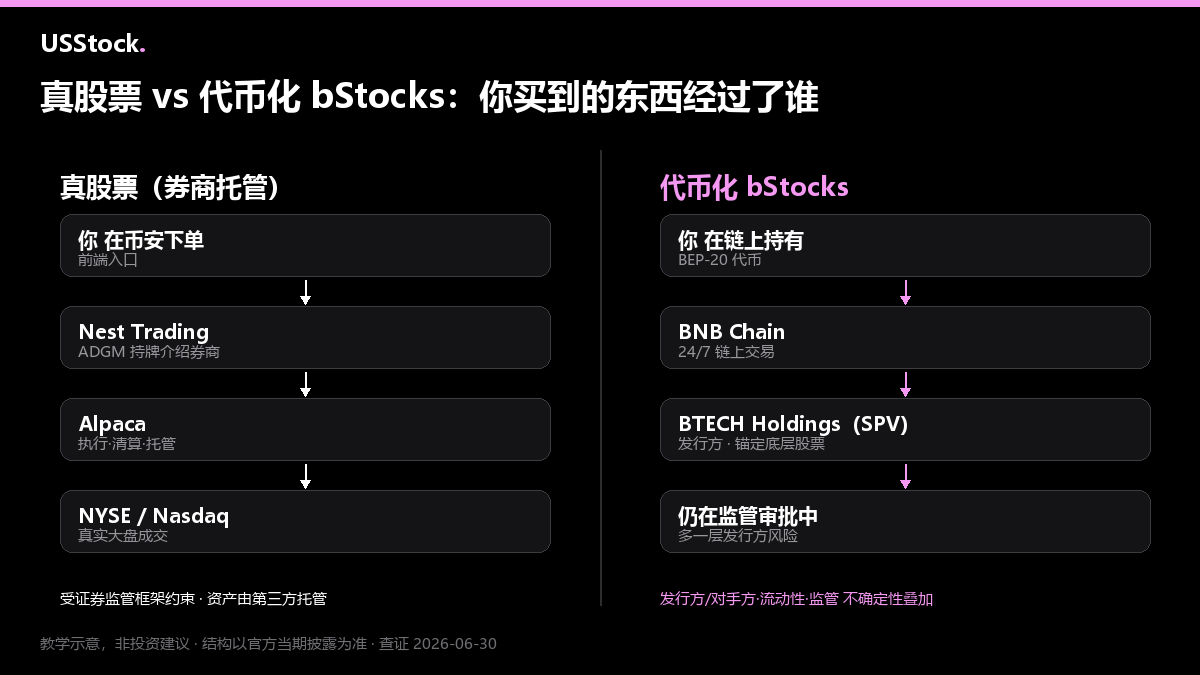
Compressing the two sections above into one table is the most intuitive way to see it. The comparison below lists each point so you can tick against your own needs. Note: there's no "which is better" column, because which column suits you better depends on what you care about and what you can bear.
| Comparison point | Real stocks | bStocks (tokenized) |
|---|---|---|
| What you hold | A stock / fractional-share entitlement, broker-held and third-party custodied | A tokenized security product, pegged to the underlying stock |
| Issuer / handling party | Arranged by a licensed broker, kept by a third-party custodian | Issued by a disclosed issuer/product arrangement |
| Trading hours | Follows US market hours; closed on weekends / holidays | Extended-hours on-chain trading |
| Instrument range | Tradable US stocks and ETFs; fractional shares supported (from about $5) | Announced / rolling-out instruments; range changes as it advances |
| Regulatory status | Open to non-US users under a compliant arrangement | Not shares; regulatory treatment may change |
| Cost structure | Zero commission*, per-order platform fee: ≤$350 about $0.35, >$350 about 0.1% | Per Binance's current terms, including on-chain-related costs |
| Dividends / corporate actions | Handled as usual (per official rules) | Per issuer arrangement, per official rules |
| Composability / use cases | Confined within the securities account | Can enter wallets / dApps, usable in on-chain applications |
| Main extra risk | Mainly market risk; structure relatively traditional | Triple uncertainty: issuer / counterparty, liquidity, regulation |
| Conversion mechanism | Not applicable | Official line: convertible under official terms |
If you'd rather pick through the comparison interactively, item by item, we've also built this table into a filterable form on the comparison page, and reading it alongside the risk notes gives you the fuller picture.
5. The three risks of bStocks, in full
The risks of real stocks are relatively familiar, mainly market volatility, and the gains and losses are yours to bear. Because bStocks add the two layers of "tokenization" and "issuer," they carry three extra risks worth pulling out on their own. I'm not going to gloss over this section, because it's exactly the part people most easily skip when they're drawn in by extended-hours trading and "on-chain is cool." For a more systematic look, pair this with our tokenization risk deep-dive.
1. Issuer / counterparty risk
The value of the bStock tokens you hold rests on the issuer/product arrangement that issues them and the arrangements behind it. That means you're effectively trusting every link in this chain: whether the issuer/product arrangement genuinely holds an equivalent amount of the underlying asset, whether the peg mechanism holds up under stress, and whether the conversion mechanism can still be honored smoothly in extreme conditions. Traditional real stocks have the layered structure of a licensed broker and third-party custody, with relatively mature institutional safeguards for asset independence; the tokenized layer, by contrast, is young in both rules and precedent. If the issuer runs into trouble, whether the "bridge" between the token in your hand and the underlying asset holds is something you must think through in advance. This doesn't mean it will definitely go wrong, but that this class of risk is far smaller on the real-stock side and amplified here.
2. Liquidity risk
Extended-hours trading sounds great, but "able to trade any time" is not "able to fill at an ideal price any time." The depth of the on-chain market, the number of participants, and the market-making situation all affect the price you can actually get at a given moment. Especially when the market is swinging hard, or when an instrument isn't much watched, the bid-ask spread may widen, and you may want to exit quickly only to find the other side of the book is thin. Real stocks rest on mature traditional-market matching, where depth is usually better assured; the liquidity of tokenized instruments depends more on the maturity of the on-chain market, which is especially worth watching in the early stage. Don't mistake "able to tap the button any time" for "able to fill at the price you want any time."
3. Regulatory uncertainty
This is the hardest of the three to control yourself. As noted, different jurisdictions may treat tokenized securities differently, and the regulatory framework for these products is still taking shape internationally. Once the applicable rules change, they may affect the product's tradable range, structural design, and even its availability in certain regions. You might operate normally today and have to adjust the moment the rules change tomorrow. Real stocks take a relatively mature compliance path, where rule changes tend to be slower-paced and more predictable; bStocks, as a new form, sit closer to the edge of regulatory evolution, and that uncertainty is an inherent part of them. Factor it into your holding expectations, rather than assuming "usable now means usable forever."
6. Dividends, corporate actions, and tax
Many people, agonizing over "real stocks vs tokenized," fixate only on the buy-and-sell moment and overlook what happens during holding: corporate actions like dividends, splits, and rights issues aren't handled identically on the two sides.
The real-stock side
Dividends and corporate actions on real stocks are handled as usual. When the underlying company pays a dividend or splits, you as an entitlement holder receive the corresponding arrangement by the rules, with the exact form and timing of receipt per official announcement. Because the structure behind it is traditional broker and custody, this process is relatively orderly.
The bStocks side
Dividends and corporate actions on tokenized instruments rely on the issuer's arrangements to map onto token holders. They may be reflected onto your token through a specific mechanism, but exactly how, in what form, and on what schedule is again per the official rules at the time. Because there's an extra issuer layer, the handling logic here doesn't fully correspond to real stocks. You can't assume "same as real stocks"; you have to look at the official bStocks documentation separately.
Tax: this isn't something I can answer for you
For both real stocks and bStocks, tax treatment depends on the rules of your own jurisdiction, and in some places the two asset types might even fall into different tax categories. I won't give specific advice here, because it's highly personal and also changing with regulation, so consult a professional where you are. For more on where our boundaries lie, see our disclaimer.
7. Eligibility: who can use this and who can't
This section looks dry, but it's the root of why many people waste their effort. Both real stocks and bStocks are open only to eligible non-US users. US users can't use these services, and whether other regions are open depends on Binance's terms; that's not a restriction from this site but a compliance boundary set by the nature of these products.
So before you study "which of real stocks and bStocks suits me," the first step is always to confirm whether your region and account status make you eligible. If you can't clear the eligibility gate, all the downstream comparison is moot. For how to confirm eligibility and which regions are restricted, we cover it separately in the eligibility section of the complete guide; nail that step down first. Also, because tokenized products are still subject to regulatory change, their available regions may shift further as rules and product terms change, which is even more reason than for real stocks to watch the official announcements at the time.
8. The cost picture: zero commission and platform fees
The cost side is easily led astray by two vague framings, so let me pull them apart.
Zero commission ≠ zero cost
For eligible non-US users, real stocks are headlined as zero commission*, but every order usually still carries a platform fee: for a single order ≤$350, about $0.35 (flat); >$350, about 0.1%. Keep these two separate: no commission charged on trade value doesn't mean there's no per-order platform fee. For people with small capital and frequent activity, that flat fee in the small-amount band is more conspicuous as a share; for those with larger amounts and lower frequency, it's more the 0.1%. To quantify its effect on your strategy, plug the numbers into the calculator on the tools page; that's the most direct way.
The cost structure on the bStocks side isn't fully identical to real stocks; beyond the platform-side fees, it may also involve on-chain-related costs, again per Binance's current terms. In short, don't apply your real-stock cost intuition to bStocks; look at each one's official fee schedule separately.
9. How to think this through (a decision framework, not a recommendation)
By now you should understand why I don't give a "which to buy" answer: this question has no answer that works for everyone. Rather than a conclusion, I'd rather give you a set of self-questions to ground the choice in your own situation. What follows isn't a recommendation, just a framework to help you sort it out.
- Have I cleared eligibility? If you're a US user, or your region falls under the restrictions in Binance's terms, the question may not even apply; confirm this step first.
- Do I care about "holding a more traditional, more mature equity arrangement," or "on-chain freedom from fixed hours, usable in wallets and dApps"? That decides whether you lean toward the real-stock or the bStocks form.
- Can I accept the three extra layers of risk? Issuer / counterparty, liquidity, regulatory uncertainty. If any one of these keeps you up at night, that's a sign the tokenized path isn't right for you at present.
- Is my activity small-and-frequent or large-and-infrequent? That affects the real weight of the platform fee on you (small amounts about $0.35 flat, larger about 0.1%), and how much liquidity matters to you.
- Am I prepared for "the rules will change"? Especially for bStocks, regulatory evolution is the norm; don't assume today's form stays fixed.
Answer these honestly and the answer usually surfaces on its own. If you're still at the beginner stage, my suggested order is: get the basics solid first, eligibility, custody, cost (the real-stock line is a better starting point for understanding), then decide whether to touch the newer, more cognitively demanding tokenized products. You can start the basics from the complete guide.
10. Common questions
Why are the prices of bStocks and real stocks so close?
Because bStocks are pegged to the underlying stock's price, and the official line is convertible under official terms, so their quote follows the underlying stock. But "close prices" is not "equivalent." The nature of what you hold, the handling party, the regulatory status, and the risk structure all differ, and those differences don't show up in the price number, yet they genuinely affect your rights.
Can I convert bStocks into real stocks?
The official phrasing for bStocks includes a conversion mechanism under official terms. Whether you can, how to do it, and whether there are conditions all follow the official rules at the time. Don't assume it's a freely reversible operation available on demand.
Does extended-hours trading make bStocks more flexible and more worth choosing?
Extended-hours access is a feature of it, but flexible doesn't mean better. The flip side of "able to trade any time" is that liquidity may worsen in off-peak hours, and that you face the issuer and regulatory uncertainty alone. Flexibility is a plus for some people and merely a tempting extra risk for others; it depends on you.
Which should a beginner touch first?
I won't draw that conclusion for you. But from a "lowest cost to understand" angle, the real-stock structure is closer to traditional intuition and easier to grasp what you've bought; tokenized products require you to additionally understand the on-chain, issuer, and regulatory layers. Getting the simple thing straight first is my personal habit with anything new, offered for reference, not as advice.
Where can I go to do this step by step?
For real shares, the path from confirming eligibility to placing a first order is in the complete Binance US-stock guide; how money gets in, and which account it has to sit in before you can trade, is written up separately in from deposit to order. If bStocks are what you want to touch first, read it backwards — start with the tokenized-risk piece, then look at the mechanics.
References and further reading
Below are the official and authoritative sources I referenced while verifying; I'd suggest opening them yourself before you act to check the current terms:
- Binance official site: product descriptions, fees, eligibility, and current announcements for both real stocks and bStocks follow this.
- US SEC official site: to follow regulatory developments related to tokenized securities.
- Investopedia: neutral background on concepts like fractional shares, ETFs, corporate actions, and tokenization.