Let me start with an honest admission. For years, if you lived outside the US and wanted to own a single share of Apple or Nvidia, your options were frustrating: open an account with a US broker and get stuck on identity and proof-of-address checks, or route money through a patchwork of third-party services that felt clunky and left you worrying about where your funds actually were. So when I heard in June 2026 that Binance had opened real-stock trading in US stocks and ETFs to eligible non-US users, my first reaction was skepticism. "Buy US stocks inside a crypto exchange" is a sentence that sounds slightly wrong. So I walked the whole thing myself, from signing up, to funding the account, to actually placing an order and buying a share, and I wrote down every spot where I got stuck and every trap worth knowing about.
This long beginner's guide answers one question: how do you actually buy US stocks through Binance if you're eligible? If you have never touched the stock market, that's fine. I'll start from "what is a US stock" and take you all the way to buying your first share by hand. I verified the figures and rules in here through June 30, 2026, but market rules, fees, and regional availability can change at any time. For any decision involving money, treat what Binance shows on its official pages at the time as the source of truth.
1. What US stocks are, and why eligible users can now buy them through Binance
A US stock is simply a share in a company listed on a US exchange, the New York Stock Exchange (NYSE) or Nasdaq. Apple, Microsoft, Tesla, Nvidia, the names you hear all the time, are US stocks. If you want to build the concept from scratch, a financial-education site like Investopedia has plenty of beginner entries to look up. Buying a share means buying a very small slice of ownership in that company: when the business does well and the market is optimistic, the price can rise; when it stumbles or the broader environment sours, the price falls too. Let me pour some cold water early: stocks going up and down is normal, nobody can predict whether tomorrow is green or red, and this guide will never recommend a specific stock or forecast a direction. It only teaches you how to operate.
Beyond individual stocks, the US market has a category called ETFs (exchange-traded funds). Think of an ETF as "a basket of stocks packaged into one." Buy one share of an S&P 500 ETF and you indirectly hold a tiny piece of 500 large US companies. For beginners, ETFs are often treated as a way to spread risk, but they also move, they can also lose money, and they are not a product where your principal is protected. If you want a more systematic grounding in how ETFs differ from single stocks, our piece on real stocks versus bStocks is a good foundation.
So why can eligible non-US users buy through Binance now? Because from June 2026 Binance opened US-stock and ETF trading to eligible non-US users. Note the key phrase: real stocks. What you buy is not some price-linked synthetic product, but a genuine share arranged by a licensed broker and held by a third-party custodian. Corporate actions like dividends, splits, and mergers are handled as usual. Specifically, orders are introduced by Nest Trading (an introducing broker under the current official disclosure), then executed, cleared, and custodied by Alpaca, connected directly to NYSE and Nasdaq. The broker and custodian follow Binance's current official disclosure; if anything changes later, the official help center is again the reference.
Why does this matter so much for eligible users abroad? The traditional path to US stocks was to open a US-based or offshore brokerage account, and identity verification, proof of address, and tax forms alone are enough to put plenty of people off. If you already use Binance for crypto, buying US stocks inside the same, already-verified account skips that whole separate account-opening step. Of course, convenient does not mean risk-free, and I'll cover risk seriously in its own section.
2. Eligibility first: who can use this and who can't
I'm putting this section up front because it matters more than any operational step: if you're not eligible, everything downstream simply won't work, and you'll have wasted your time. When I first looked into this, I ran straight into this wall too. Not every region can use the feature.
The eligibility red line: this feature is open only to eligible non-US users. US users can't use the US-stocks feature. Availability by region, which instruments are tradable, and whether extra compliance verification is required are all decided by Binance according to local regulatory requirements. Whether you can use it where you live, and how much of it, comes down to the actual availability status shown inside your own account when you open Binance's official pages.
Beyond region, there are usually some basic thresholds: your Binance account needs to have completed identity verification (KYC), be in good standing, and not be restricted from trading. If your account has only seen light use and your verification tier is low, you may need to complete more verification before US-stock trading becomes available to you. This step varies from person to person; follow the prompts inside your account.
A quick self-check
- Am I an eligible non-US user (not a US user, and not in a region Binance's terms restrict)?
- Has my Binance account completed identity verification?
- When I open the US-stocks pages, does the account show "tradable" rather than "not yet available"?
- Do I understand this is real stock investing, with real potential for loss, and not a principal-protected savings product?
Confirm all four, then move on. If any one is in doubt, verify it in the official help center first. Don't rush to fund the account.
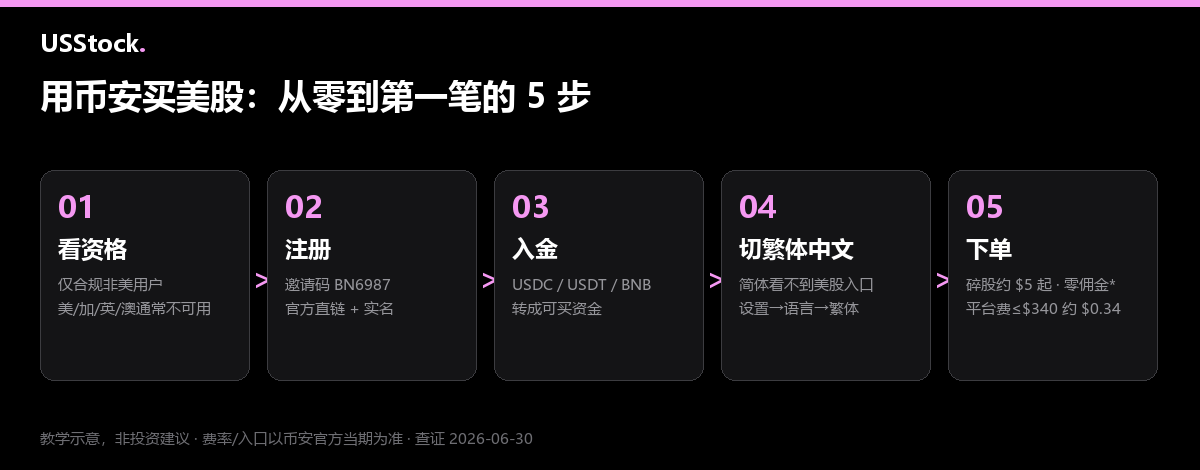
If you don't have a Binance account yet, the first step is to sign up. This part isn't complicated; the real time sink when I did it was waiting for identity verification, not filling in forms. Here's the order.
- Open the registration page, sign up with an email or phone number, and set a strong password.
- Turn on two-factor authentication (2FA) immediately. Don't cut this corner: buying US stocks means real money and real assets in your account, and using an authenticator app for 2FA is a basic security floor.
- Complete identity verification (KYC): upload your ID and follow the prompts for the face check. Review time depends on the current queue; I waited a short while, not long, but not instant either, so leave yourself time. You don't want to find out verification hasn't cleared at the exact moment you're ready to place an order.
- Once verified, return to the US-stocks entry and confirm the account shows a tradable status.
From experience: if you can't find the US-stocks entry, switch to Traditional Chinese first. The Binance US-stocks feature currently shows only under the Traditional Chinese interface; you won't see the entry under other language settings. If you hunt around and can't find the "traditional finance / stocks" module, go into the app and switch the display language to Traditional Chinese (Settings, then Language, then Traditional Chinese), and the entry usually appears. This follows Binance's current behavior and may change later.
One thing that's easy to overlook during sign-up: the security of your email and login devices. My habit is to use a strong, dedicated password for Binance that isn't shared with any other service, and to keep track of my usual login devices. Crypto and securities accounts are prime phishing targets, and anyone claiming to be "official support" who asks you to transfer funds or read out a verification code is a scammer. The real team will never ask for your 2FA code. For spotting investment scams, the US consumer resource Investor.gov has dedicated guides worth a look. On security habits, Binance's own help center has a section too; it's worth ten minutes.
If you've thought through eligibility, cost, and risk, and confirmed you're an eligible non-US user, the next step is to open an account on the Binance sign-up page (invite code BN6987 pre-filled), then continue with section 3 below to finish verification and funding. That is an affiliate link; signing up through it normally does not raise your own costs. Fees, available regions and any campaign conditions follow whatever the Binance page shows at the time.
3. Funding: turning money into a balance you can trade with
Once the account is ready, your balance needs money in it before you can buy stocks. This works a little differently from the traditional broker model of "link a bank card and it deducts directly." In this system, funding is usually done through stablecoins or supported fiat currencies.
Per Binance's current terms, the funding forms usable for these trades include USDC, USDT, BNB, USD1, and USD, among others (which ones are supported, and whether it varies by region, follow the official page at the time). If you're already a Binance user with USDT or USDC sitting in your account, this step is almost done for you. If you're brand new, you'll first need to convert outside funds into one of those forms.
Two common funding approaches
| Method | Who it suits | What to watch for |
|---|---|---|
| Already hold stablecoins, transfer within the platform | Existing Binance users with USDT/USDC in their account | Confirm funds are in the correct account/wallet, and transfer them to the location you can trade from |
| Buy stablecoins with a supported fiat currency or channel | New users with no crypto assets on hand | Different purchase channels have their own fees and settlement times; check before you act |
My honest read is that what trips up beginners isn't the act of funding itself, but "which account/sub-account do the funds need to be in before I can buy stocks." Binance has different internal account areas, and money can end up sitting somewhere you can't trade from directly. I got stuck here at first: the balance was clearly there, but the order page showed zero available, and only later did I realize I needed to move the funds to the right place. So after funding, don't rush; first confirm the order page recognizes your available balance. We break this down fully in from funding to your first order, which reads well alongside this guide.
A small note on exchange rates and costs: if your principal started as some other currency and went through a "local currency to stablecoin/USD" conversion, the exchange rate and channel fees along the way are hidden costs, separate from the fees for buying stocks later. To estimate your total cost, run a rough calculation first with the exchange-rate and fee tools on our tools page, so you go in with eyes open.
4. Buying real stocks: tickers, fractional shares, zero commission* and how the platform fee works
Finally, the core step: actually buying a share. I've split it into a few small actions; just follow along.
1. Use the ticker to find the stock you want
Every US stock has a "ticker," a short letter abbreviation: Apple is AAPL, Microsoft is MSFT, Tesla is TSLA, and a common S&P 500 ETF is SPY. These companies are listed on Nasdaq or the New York Stock Exchange. Type the ticker or company name into the search box on the US-stocks trading page and you'll find the matching instrument. If you're unsure of a company's ticker, check it first with the ticker lookup on our tools page to avoid buying a same-named or similar-named instrument by mistake, a genuine beginner error.
2. Fractional shares: you don't need a whole share
Many popular US stocks aren't cheap per share; a single share can cost hundreds of dollars. Fortunately, Binance supports fractional shares, from about $5, meaning you can buy "a fraction of a share." That's friendly to beginners with a small amount of capital who still want to spread across a few names. For more on fractional shares, such as how they're handled for dividends and corporate actions, we cover it separately in how to buy fractional shares.
3. How zero commission* and the platform fee actually work
This is the point I most want to make clear in the whole guide, because "zero commission" is the phrase most easily misread. Here's the conclusion first:
- Non-US users pay no ordinary broker commission on US stocks*. That is all "zero commission" means: the commission line is $0.
- Every order still carries a platform fee: about $0.35 (fixed) up to $350, about 0.1% above $350. So zero commission is not zero cost; small orders have a small flat fee underneath, and larger ones pay a percentage.
Here's an illustration of the math (the numbers show the principle; the actual rates follow Binance's current terms): if you spend a small amount on a stock, that roughly $0.35 platform fee (flat up to $350) becomes one of your order costs. The smaller the amount, the higher a share of your principal that $0.35 represents. Buy just $5 and that flat fee alone is about 7% of the order. Above $350, the platform fee switches to about 0.1% (buy $1,000, about $1; buy $10,000, about $10). So while fractional shares have a low barrier, if you keep buying very small amounts and trade frequently, these flat fees add up in a way that isn't in your favor. My advice: think it through before you order, and don't treat it as a zero-cost game to trade in and out of.
4. Placing the order: market or limit
Once you've chosen the instrument and entered an amount or share count, it's time for the order type. The two most common are a market order (fills as soon as possible at the current market price) and a limit order (you set a price, and it only fills when the market reaches it). Beginners often reach straight for a market order for convenience, but understand this: a market order fills fast, yet the fill price can differ slightly from the quote you saw, especially in volatile moments. My own first time, I tested the waters with a very small amount and a market order, just to get the flow working before worrying about anything else. I won't quote a specific fill price or amount here, because it wouldn't be meaningful to you; everyone's order timing is different.
5. About trading hours
US stocks aren't buyable 24 hours a day; they have fixed market hours and close on US public holidays. For users across different time zones, the regular US trading session often falls in the middle of your night. Some platforms offer pre-market and after-hours sessions, but liquidity and price movement differ from the regular session. When you can trade, and what to do around US holidays, we cover in market hours and holidays; you can also check whether the market is open right now with the market-status tool. Official trading sessions and holiday schedules can also be confirmed on the NYSE site.
5. After you buy: holding, dividends, watching the market
Buying is only the beginning. Once you've bought, what you hold is a real share; it moves with the market, and you can choose to hold long term or sell when you think the time is right (selling follows the same order rules and fee logic).
Dividends and corporate actions
Since these are real stocks, if the company pays a cash dividend, you as a holder are entitled to the corresponding amount in proportion to your holding; for corporate actions like splits and mergers, they're processed by the rules. All of this is arranged behind the scenes by the licensed broker and custodian, and you'll see the relevant changes recorded in your account. Exactly when a given dividend lands, and in what form, follows the official and then-current announcements.
How to watch the market without letting emotion steer you
The most down-to-earth advice I can give a beginner: don't stare at the minute-by-minute red and green. Short-term swings are normal; a stock moving up and down within a single day is the market's ordinary state, and the more closely you watch, the more likely you are to make an impulsive decision. The point of watching is to know the rough state of what you hold, not to manufacture anxiety for yourself. Whether to hold long term or trade short term is your own investment judgment; this site offers no specific advice and predicts no direction, a red line we always keep.
To run through the variables, total cost, exchange rates, market hours, before you actually buy, work through them one by one on our tools page; to compare different ways of holding side by side, see the comparison page. The tools compute the numbers; the judgment is still yours.
6. Real stocks vs bStocks, in one line
Many beginners confuse "real stocks" with tokenized-stock products like bStocks, so here it is in the shortest possible terms: a real stock is a genuine share you actually hold, arranged by a licensed broker and held by a third-party custodian; bStocks-style tokenized products are a different form of thing entirely, with different rights structures, trading hours, and risk characteristics. They are not the same, so don't blur them together.
For the vast majority of eligible users who just want to "own real US stocks," sticking to the "real stocks" path is enough. If you also want to understand what tokenized stocks actually are and exactly how they differ from real stocks, we have a full dedicated comparison: real stocks vs bStocks, in full, or go straight to the side-by-side table on the comparison page to see the differences at a glance. Before you understand the difference, don't rush into ordering a tokenized product.
7. Common questions
Q: I'm abroad, can I actually use this?
See the eligibility red line in section 2. As long as you're an eligible non-US user with a properly verified account, you generally can; US users can't, and elsewhere Binance's terms decide. The most accurate check is to open your own account and see whether the US-stocks entry shows as tradable.
Q: Do I really own the stock, or is it just price-linked?
The US-stocks feature in this guide buys you a real stock, arranged by a licensed broker and held by a third-party custodian, with dividends and corporate actions handled as usual. That's different from certain synthetic products that "only track the price." For the difference between real stocks and tokenized products, see section 6.
Q: Does zero commission mean it costs nothing at all?
No. "Eligible non-US users buy US stocks with zero commission*" means there's no traditional commission, but every order still carries a platform fee: for a single order ≤$350, about $0.35; >$350, about 0.1%. On top of that, if your principal has to go through a currency conversion, there's an exchange-rate cost in the middle too. For details, see the truth about zero commission.
Q: I have very little capital, is it worth buying?
Fractional shares from about $5 do lower the barrier a lot, but note that the roughly $0.35 flat platform fee weighs heavily on small orders, so frequent small trades aren't cost-effective. How much you buy, or whether you buy at all, is your own decision; this site makes no recommendation.
Q: Do I need to open a separate US brokerage account?
No. That's exactly what makes this path friendly to eligible users abroad: you operate inside your already-verified Binance account, skipping the whole process of separately opening a US-based brokerage account.
8. Risk and disclaimer
By this point, the operational side is basically covered, but this last section is the one I most want you to read carefully. Buying stocks is investing, and investing carries risk. That's not boilerplate.
- Market risk: prices go up and down, and you can lose principal. Nobody can predict short-term direction, and any claim of guaranteed profit or zero loss of principal is not credible.
- Exchange-rate risk: if there's a currency conversion between your principal and USD, the exchange-rate movement is itself an extra layer of uncertainty.
- Cost: zero commission is not zero cost. The platform fee (≤$350 about $0.35, >$350 about 0.1%), plus any currency-conversion cost, all have to be counted in.
- Eligibility and compliance risk: this feature is open only to eligible non-US users, and the rules and available regions may change with regulation.
- Operational and security risk: buying the wrong ticker, placing the wrong order, getting phished. These human risks have nothing to do with the market, but they'll cost you money just the same, so be careful.
What this site is: educational grounding in US stocks and how-to teaching for using Binance. We recommend no specific stock, predict no direction, and promise no returns. Nothing you read here is investment advice. Before you actually order, judge independently based on your own situation, and consult a qualified professional where necessary. See the full disclaimer.