Almost everything written about tax and US stocks stops at the US border. You read that dividends get withheld at source, you learn a treaty might reduce the rate, you tick through a W-8BEN in the account flow, and the matter feels closed. It usually isn't. The country that treats you as a tax resident has a claim of its own, decided by its own law rather than by whatever the United States did first.
This piece is about that second layer: whether US-stock income has to be declared where you live, whether you can pay on the same money twice, what the general machinery for relief looks like, and where to look up the parts that depend on your jurisdiction. Written and checked on September 6, 2026. Educational only, and not tax, investment or legal advice — for your own position, speak to a licensed tax professional where you actually file.
1. The US layer is not the whole bill
For a non-resident foreign investor, the IRS treats US-source dividends as fixed or determinable, annual or periodical income, taxed at a flat 30% rate, with no deductions allowed and a lower treaty rate available where one applies and has been properly claimed. The money is reduced before it reaches you, which is why a credited dividend looks smaller than the figure the company announced.
Where people go wrong is in deciding what that deduction settles. It settles a US obligation, and nothing more. In many jurisdictions the same dividend still has to appear on a domestic return, with the US tax already suffered treated as something to be relieved rather than as proof the matter is finished. The American side — the rate, the treaty question, how W-8BEN works and how long it stays valid — is covered separately in US dividend withholding tax and W-8BEN. If that is new to you, read it first; this page assumes it.
2. Tax residence is not your passport
Everything downstream turns on one question: which jurisdiction, or jurisdictions, treat you as a tax resident. There is no global rulebook. Each jurisdiction writes the test into its own domestic law, and the tests genuinely differ — days of physical presence, where your home and economic interests sit, sometimes registration or citizenship. Drafted independently of one another, they overlap, and one person can satisfy more than one of them in a single year.
That is why passports mislead. A passport evidences nationality; a utility bill evidences where you sleep. Either can feed into a residence test somewhere, but neither is the answer on its own, and someone who moved countries in March while assuming the old rules held in December is the ordinary version of this mistake.
The sane starting point is the OECD's tax-residency page on its automatic exchange portal, which gathers, jurisdiction by jurisdiction, how each one defines tax residence: OECD — tax residency rules by jurisdiction. It will not hand you a verdict on your own case; it points you at where each jurisdiction publishes its rules, which beats arguing from a forum thread.
3. Gains, and the 183-day wording
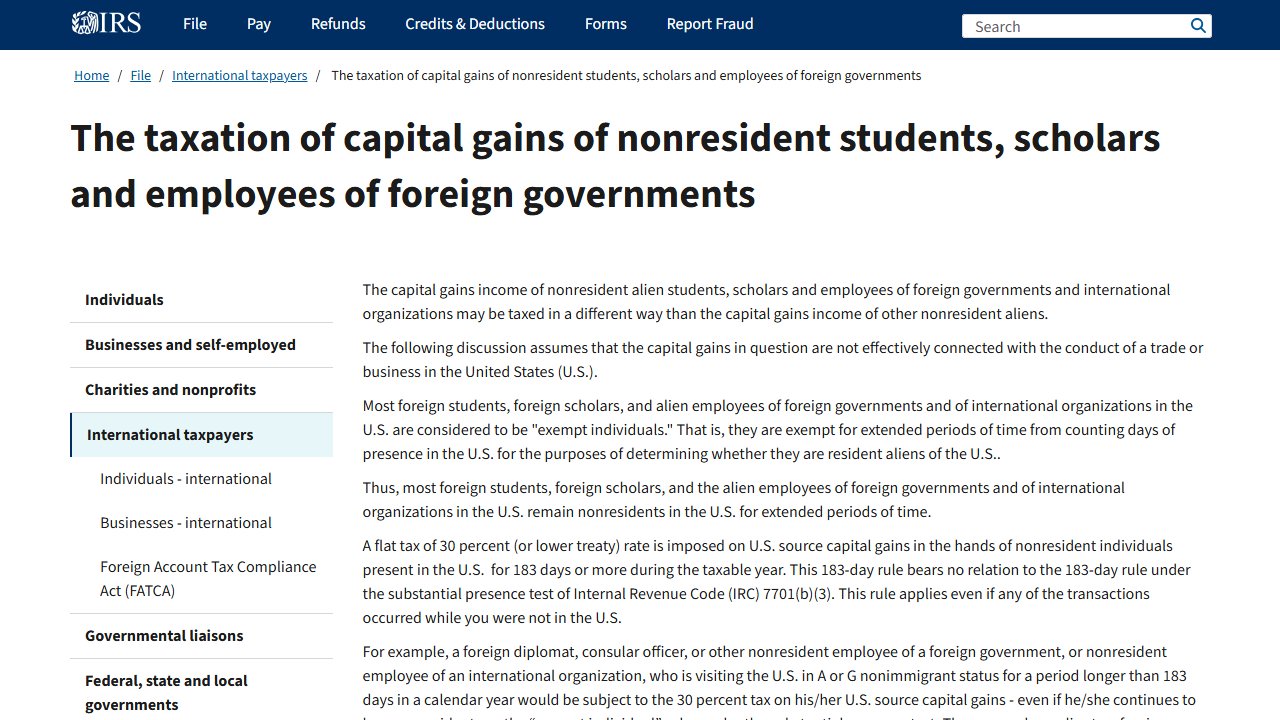
Now the narrower question, where careless writing is everywhere. The IRS page that spells this rule out is written for nonresident students, scholars and employees of foreign governments, though the sentence itself is framed around nonresident individuals generally: a non-resident alien who is present in the United States for 183 days or more during the tax year is taxed at 30%, or a lower treaty rate, on US-source capital gains. That presence condition is the shape of the rule as published on that page — see IRS — the taxation of capital gains of nonresident alien students, scholars and employees of foreign governments, alongside the broader IRS — taxation of nonresident aliens.
What that page does not do is issue a blanket clearance for everyone below the threshold. Secondary sources make that leap constantly, compressing a presence-based rule into a slogan about tax-free gains. If you spent a long stretch in the United States during the year — a semester, a secondment, a family visit that quietly ran past a season — the day count stops being a technicality. And whatever the US concludes, your residence country reaches its own conclusion about the same gain, on its own timetable.
4. Exemption or credit
So how does anyone avoid paying twice on one dividend? The machinery comes from the OECD model tax convention, the template most bilateral treaties are drafted against. It sets out two parallel methods for eliminating double taxation, and each treaty specifies which method the residence state applies — some combine them, using one method for most income and another for dividends and interest.
- The exemption method: the residence country leaves the income out of its own tax base where the source country was entitled to tax it, while often keeping the right to take that income into account when setting the rate on everything else. An exempt amount can still nudge your other income into a higher band.
- The credit method: the residence country taxes the income, then allows a deduction for tax already paid in the source country, capped at its own tax attributable to that foreign income.
That cap is the sentence worth memorising. Where your residence country's tax on the dividend comes out lower than what the US withheld, the credit typically relieves you only up to your domestic tax on that income; the excess does not automatically reappear from anywhere. And if you never claimed a treaty rate on the US side to begin with, you may have suffered more withholding than a treaty would have allowed, while still being limited at home by the same ceiling.
5. Account details already cross borders
A belief that survives longer than it should: that an account held outside your home country is invisible to the authority you file with. Under the Common Reporting Standard, participating jurisdictions collect account information from their financial institutions and exchange it with other jurisdictions automatically, once a year, as routine rather than on request.
This is also why the self-certification you signed during onboarding matters more than it looked at the time. Those forms ask you to declare every jurisdiction in which you are tax resident, plus the taxpayer identification number for each, and the full list is what they expect. If your circumstances have changed since, keeping that declaration current is your responsibility. The OECD's automatic exchange portal publishes, jurisdiction by jurisdiction, which places have committed and who they exchange with.
None of this is cause for alarm if your filings are honest. It just means the picture your authority receives and the one on your return should match.
6. Records worth keeping
Whichever method applies, it will want evidence, and evidence is easier to keep than to reconstruct. Export and store your trade history, the fees charged on each order, the dates and amounts of dividends actually credited, and anything documenting tax already withheld. Where that export lives is a moving target; go by what the current Binance pages show rather than by a menu path someone described last year. What the platform's own tax reports cover was left unchecked here, so treat any single downloadable file as a starting point and keep your own copies alongside it.
If I could keep only one thing, it would be the dividend line as it actually landed — credited amount, date, currency — since the announced figure per share stays easy to find later while the net number on the day does not. Fees deserve the same habit; how commission and platform fees separate out is set out in the zero-commission truth.
Frequently asked questions
Does my home country tax my US stock gains?
That depends on the country in which you are tax resident, since each jurisdiction decides in its own law what it taxes. Relief for foreign tax then comes through an exemption or a credit under its treaty. No answer holds everywhere, and no individual country's treatment was checked for this guide.
I already had 30% withheld on my dividends. Do I still have to declare them at home?
Very possibly. The US withholding settles the US side of the bill, while your domestic filing duty runs on its own track. In a credit-method jurisdiction the usual pattern is to report the gross dividend and claim relief for the foreign tax, limited to your own country's tax on that income. Treat the deduction taken at source as one input to that calculation — the US tax already suffered, waiting to be relieved at home.
Is my tax residence just wherever my passport is from?
No. Residence for tax purposes is set by each jurisdiction's own law, and the common tests look at days of presence or where your personal and economic ties sit. Some jurisdictions do attach residence to citizenship, which is why the rule cannot be read off a passport.
Can I be tax resident in two countries at once?
Yes, and more often than people expect, because the tests are written independently and can both be satisfied in one year. Treaties usually contain rules for sorting out which jurisdiction wins for treaty purposes — which is also why account self-certifications ask for all of your residences.
My broker account is offshore. Will my tax authority actually find out?
Assume the information moves. Under the Common Reporting Standard, jurisdictions gather account data from their financial institutions and exchange it annually. Plan on the assumption that your authority already has the account data.
Where to check next
For anything country-specific — rates, forms, deadlines, thresholds — go to your own revenue authority's published guidance, and where the amounts matter, to a licensed local adviser.
- On this site: US dividend withholding tax and W-8BEN, dividends and corporate actions, US stocks for beginners, non-US eligibility, is it safe.
- Everything else we have written, in one list: all guides.